


CaeSAR
Four Summer Schools in 2026 to Strengthen the Region’s Scientific Attractiveness
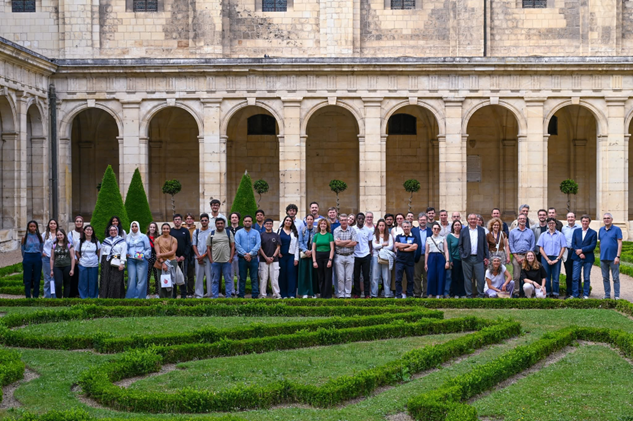
From spectroscopy to artificial intelligence and nuclear physics, the CaeSAR project supported four summer schools in 2026, bringing together a total of 125 participants in Caen and at scientific sites across the region.
Beyond their educational dimension, these summer schools were key events for scientific community. They provided opportunities to share knowledge and expertise, foster exchanges and collaborations, and introduce participants to the region’s scientific infrastructures and areas of expertise.
SPECTROCAT 2026: Spectroscopy for Catalysis
Organised by the Laboratory of Catalysis and Spectroscopy (LCS) in partnership with ENSICAEN and University of Caen Normandy, the SPECTROCAT 2026 summer school, dedicated to vibrational spectroscopy applied to catalysis and adsorption, took place from 29 June to 3 July and brought together 40 participants.
The summer school had a strong international dimension, with 80% of participants coming from foreign institutions, mainly from European countries — Germany, Finland, Italy, Norway, the Netherlands, Portugal, Switzerland and the Czech Republic — as well as from Turkey and North and South America.
The programme alternated theoretical lectures in the morning with practical sessions in the afternoon, enabling participants to deepen their knowledge and proficiency in IR and Raman spectroscopy techniques, as well as their in situ and operando applications.
The opening of this first summer school was marked by a special institutional event, with a ceremony held on 1 July at Hotel de Ville de Caen, attended by Christophe Rochais, Vice-President for Research and Innovation at Université de Caen Normandie, Gilles Ban, Director of ENSICAEN, and Ludwig Willaume, representing the City of Caen. The event highlighted the support provided by local stakeholders for scientific initiatives and training activities carried out as part of the CaeSAR project.
AI4SCIENCE 2026: Artificial Intelligence for Science
Organised by GREYC Labolatory in partnership with ENSICAEN and Université de Caen Normandie, the AI4Science 2026 summer school brought together 47 participants from 29 June to 3 July.
For its third edition, the school focused on new artificial intelligence methods applied to scientific research. Participants explored generative and diffusion models, Bayesian models, transformers applied to multidimensional datasets, as well as new approaches based on the use of AI agents in science.
Through a combination of theoretical and practical teaching, the aim was to equip researchers and students with the tools needed to harness artificial intelligence in their work, thereby helping to accelerate and enrich scientific discovery processes.
Physics of Nuclear Open Quantum Systems: Exploring the Heart of Theoretical Nuclear Physics
Organised by GANIL in partnership with Université de Caen Normandie, the Physics of Nuclear Open Quantum Systems summer school took place from 6 to 24 July and brought together 25 participants to explore modern theoretical approaches to open quantum systems.
Over the course of three weeks, participants attended lectures delivered by international experts and explored a range of topics in theoretical nuclear physics, including scattering theory, continuum models, and the study of weakly bound and unbound nuclear states.
The school also provided a valuable opportunity to foster scientific exchanges around cutting-edge research topics and to showcase the expertise of GANIL and Caen’s scientific community in the field of nuclear physics.
Summer School on Fundamental and Applied Nuclear Physics: Sharing Knowledge in Nuclear Physics
The final event in this programme, the Summer School on Fundamental and Applied Nuclear Physics, was organised on 3 and 4 September by the Laboratory of Nuclear Physics (LPC) in partnership with Université de Caen Normandie. It brought together 12 students, 80% of whom were enrolled in the Erasmus Mundus Master’s programme offered by the LPC.
The summer school focused on major issues in fundamental nuclear physics and its applications. International experts addressed topics including the history of major discoveries in nuclear physics, few-body calculation methods applied to neutron-rich nuclei, and the many applications of nuclear physics.
A Programme Supporting Scientific Attractiveness
This programme fully reflects CaeSAR’s ambition to strengthen the region’s scientific attractiveness, promote the transmission of knowledge, and create more opportunities for interaction between different research communities.
These four events also helped strengthen ties between partner institutions and laboratories — Université de Caen Normandie, ENSICAEN, GANIL, LPC, LCS, GREYC and their scientific partners — while giving participants, a significant proportion of whom came from abroad, the opportunity to discover Caen’s scientific ecosystem.
Through its support for these initiatives, CaeSAR is helping to enhance the profile of Caen and Normandy as a hub for education, research and scientific cooperation at both national and international level.